Why agencies can't use Box for client file sharing
Box is built for enterprise IT teams, not creative agencies or client-facing businesses. Here is what users actually experience — and what a better alternative looks like.
Why agencies and client-facing businesses cannot use Box for file sharing
Box has a 1.2 out of 5 on Trustpilot based on 282 reviews. Over 90% of those reviews are one star. The company has not responded to a single negative review on the platform.
That number is worth sitting with for a moment. Box is not some obscure startup that nobody checked. It is an enterprise file sharing platform that has raised over $500 million in funding and counts Fortune 500 companies among its clients. And nearly every individual user who bothered to leave a public review left one star.
The most common complaints are not about missing features. They are about billing practices, locked accounts, data held hostage, and customer support that either does not exist or actively obstructs people trying to leave. This article covers what that looks like in practice, and why the platform was never built for agencies or client-facing businesses in the first place.
Box is designed for enterprise IT, not agencies

Before getting into the complaints, it is worth understanding who Box is actually built for. Box's primary customers are large enterprises: legal teams, healthcare organizations, financial institutions, and government agencies that need compliance controls, audit trails, and integration with Active Directory. Their enterprise sales motion is built around IT administrators, not agency owners.
This is not a criticism. It is just what the product is. The problem arises when a small agency or freelancer tries to use Box because someone sent them a file link, or because they are looking for a Dropbox alternative and Box shows up in the search results. What they find is an enterprise product with per-user pricing, a three-user minimum, a sales team focused on upgrades, and a billing department that is much easier to get into than out of.
Vincent, a reviewer from the Netherlands with over 100 verified reviews, has been documenting his experience with Box across multiple posts. He describes spending hours every single time he needs to create a file share, fighting an interface where permissions contradict themselves: share options labeled "as editor" that still only allow downloads, collaboration settings that cannot be applied consistently, and a feedback link that returns an error saying it has been disabled by the administrator. He first wrote about these issues in 2023. Two years later, in 2025, he returned to update his review. Nothing had changed.
Tom Elliott from the UK described a more serious failure: a user accidentally deleted a root folder, and when the team tried to restore it through the admin panel, thousands of files came back with no folder structure. Months of organized work turned into an unstructured dump. The team then tried to export everything manually before leaving Box, discovered that downloading through the standard interface was so slow the connection would break, and ultimately had to pay extra to access their own files through an FTP client. Customer support responded by pasting FAQ links.
The billing trap
The single most recurring complaint across Box's Trustpilot reviews is not about the product. It is about what happens when you try to stop paying for it.
The pattern is consistent across dozens of accounts. A user signs up, either intentionally or because they created an account just to access a file someone sent them. Box converts that into a paid subscription. Auto-renewal fires without a clear notification. When the user contacts support to cancel or get a refund, they are told the terms do not allow it. The cancellation flow either does not work or does not exist at the account level — the auto-renewal feature is controlled by Box, not the customer.
Sally, a reviewer from Australia, discovered this directly. When she asked Box to confirm her cancellation, their support agent told her that auto-renewal is not a setting customers can turn off — only Box can disable it, and it is not visible anywhere in the account interface. She escalated to her bank, consumer protection authorities, and a consumer magazine before Box agreed to process a refund. Her review documents this step by step.
John Darby from the US created an account for the sole purpose of viewing a document someone sent him. A month later, Box started charging him $60 per month. He was denied a refund.
John Chillingworth from the UK describes a nearly identical experience: free trial, followed by an annual invoice for $840.40, no way to cancel, and eventually cancelling his credit card as the only practical exit.
Denise Wong from the US submitted two support tickets and filed a Better Business Bureau complaint after an accidental charge of $1,680. She received no response and eventually had to cancel her card to stop the charges.
A reviewer using the name "Burned" from the US describes trying to reduce the number of seats on their account after a team change. Adding seats is instant and easy. Reducing seats requires calling a number, being transferred to billing, emailing a separate address that does not respond, and submitting a support ticket that also does not respond. The seats stay active. The billing continues.
This is not a series of isolated complaints. It is a documented pattern spanning years with no indication of correction.
The interface problem
Beyond billing, Box has a persistent usability problem that shows up consistently in reviews from power users who are trying to do relatively simple things.
Sharing files with external collaborators — the core task an agency needs to perform — involves navigating a permission system that multiple experienced reviewers describe as self-contradictory. Options that appear to allow external editing do not actually grant upload rights. The path to create a shared folder where someone outside the organization can upload files is documented differently in different parts of the interface and often does not work until you find an obscure secondary setting buried inside the folder view.
For an agency delivering work to clients, this is a daily friction problem. Every time you need to share a deliverable, you are re-learning a system that does not behave consistently.
Lucas Hillmann Holm from Denmark notes that two-factor authentication — a basic security feature — is not included in Box's lower-tier plans. For a law firm, consulting practice, or agency handling sensitive client material, this is not an acceptable limitation.
What Box charges for what it delivers
Box's business pricing starts with a mandatory minimum of three users at around $15 to $20 per user per month. A one-person freelancer or a two-person studio cannot start a plan — they pay for three users regardless. P Tarr from Canada was paying $1,500 per year for 600GB of storage with no option to increase it. SV Productions, a company from the Netherlands on an Enterprise Plus subscription at over €1,600 annually, spent more than a month dealing with a failed 13TB data migration, bounced between support agents with no resolution.
The value equation does not hold up even at the premium tier.
Why this matters for agencies specifically
Agencies need file delivery to be reliable, fast, and invisible to clients. When a client clicks a link and ends up in an enterprise collaboration interface, asked to create a Box account or log into one they may not remember, that is friction in the delivery of your work.
Box was not designed to be invisible. It was designed to be the platform. When you share files through Box, your client interacts with Box, not with you. There is no option to put your domain on the link, no option to configure the notification email to come from your address, no option to present a branded download experience. Every file delivery you make is another advertisement for Box.
For internal enterprise file management, these may be acceptable tradeoffs. For an agency delivering finished work to clients, they are not.
What a file delivery platform for agencies looks like
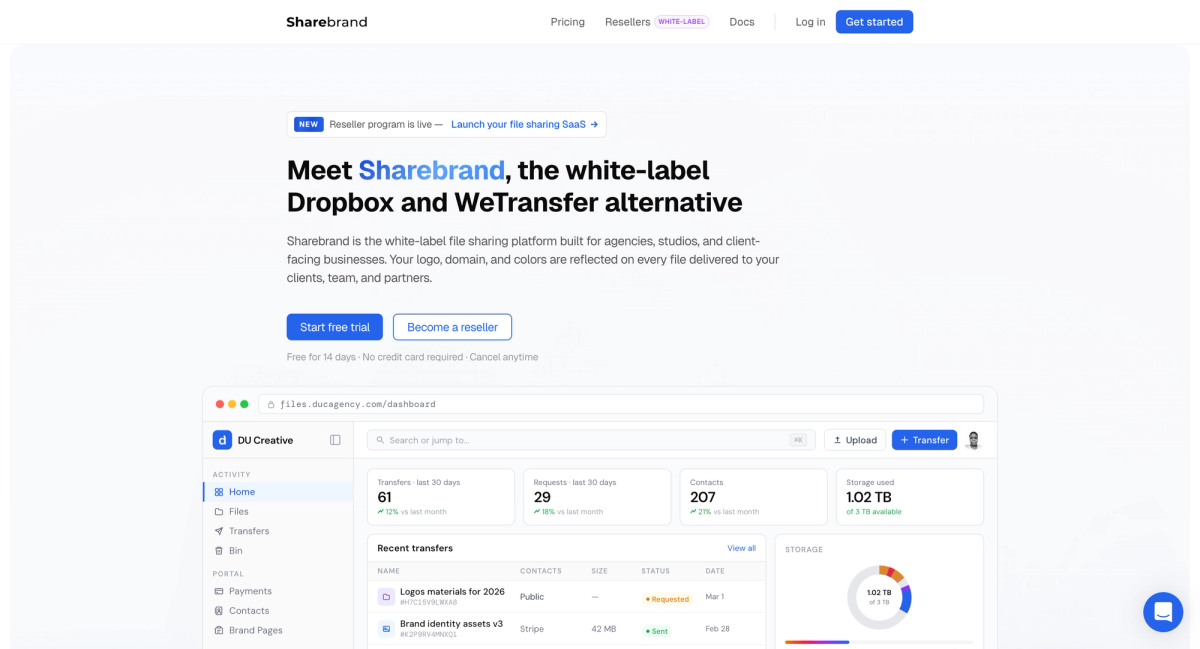
A platform built for this use case handles the things Box cannot or will not do: file delivery on your own domain, under your branding, with email notifications from your address. Your clients never see the name of the tool you are using. The interface does not require them to create an account or navigate someone else's enterprise collaboration system. They click a link, they see your brand, they download the file.
Sharebrand is built for this. Starter plan at $29 per month, Pro at $59 per month, flat pricing with no per-user fees beyond included seats. The free trial runs 14 days and does not require a credit card. You enter your card after you have actually seen the product and decided you want to keep using it.
Pricing is transparent. Billing is straightforward. If you decide to leave, you can cancel from your account settings. Your files are stored across two independent enterprise-grade systems — Cloudflare's infrastructure as primary, Backblaze as backup — so data loss is not a realistic risk. We have never held a customer's data hostage and do not intend to start.
Box is a capable product for the audience it was built for. That audience is not agencies and client-facing businesses.
Sharebrand is a white-label file sharing platform for agencies, studios, and client-facing businesses. Files delivered on your domain, under your brand, with a 14-day free trial and no credit card required. Start at sharebrand.io.