White-label Dropbox alternative for digital agencies
Dropbox works well as personal cloud storage, but it was never built as a white-label solution. Here is what agencies and client-facing businesses use instead.
Dropbox is not a white-label platform, and that is not going to change
Dropbox is a well-built product. It syncs reliably, most people know how to use it, and for teams storing and sharing files internally, it does exactly what it promises. This article is not here to argue otherwise.
The problem is not what Dropbox does. The problem is what it was never designed to do: let you put your brand in front of your clients and disappear entirely from the experience.
If your business shares files with clients as part of a service you deliver — deliverables, reports, proofs, contracts, creative assets — the file link your client receives matters. Right now, that link is a Dropbox link. The page your client lands on is a Dropbox page. If they need to do anything with the file beyond downloading it, they may need a Dropbox account. And the email notification they receive, if any, comes from Dropbox.
None of that is your brand. All of it is Dropbox's.
Why this matters more than it seems
For businesses that sell a service, every client touchpoint either reinforces your authority or quietly dilutes it. When a law firm sends a client to dropbox.com to retrieve confidential documents, or when a creative agency delivers a brand identity package through a consumer cloud storage link, that is a missed opportunity at best and a credibility problem at worst.
Clients notice. They may not say anything, but they are deciding how professional you appear based on every detail they experience. A link that lives on your domain, a file page that shows your logo, an email notification that arrives from your address — these details tell your client you have your act together. A generic Dropbox link tells them you are using the same tool as their teenagers.
This is not hypothetical. Studios, agencies, consultancies, and professional service firms deal with this problem every day. They pay for Dropbox because it works, then discover that the client-facing experience is entirely Dropbox-branded, with no real path to changing that.
What Dropbox actually offers on branding
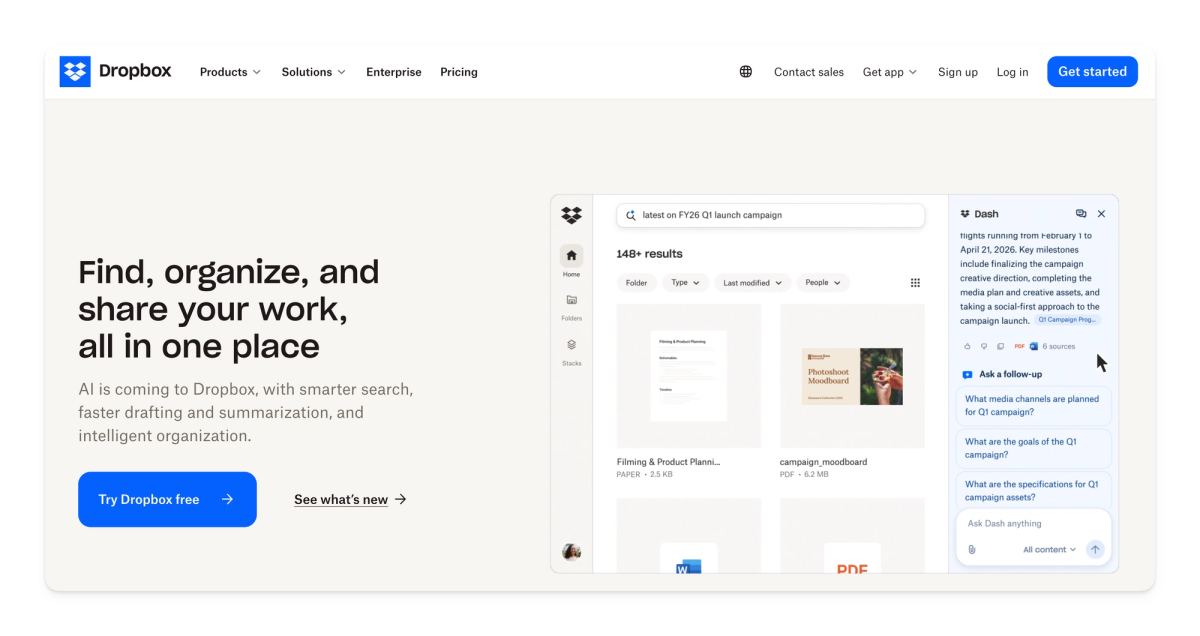
Dropbox Business and Business Plus plans include some team management features. They do not include white-label domains, white-label email, or a client-facing experience that removes Dropbox from the picture.
Dropbox Paper and Dropbox Transfer allow some customization of individual transfer pages, but the destination is still a dropbox.com URL. There is no option to send files from files.youragency.com. There is no option to configure the notification email to come from your own domain. There is no option to build a branded portal where your clients access only your files, under only your identity.
Dropbox has a reseller program, but that is for selling Dropbox to clients with volume pricing. It does not change what your clients see. Their experience is still Dropbox.
This is not a gap waiting to be filled. White-label delivery has never been part of Dropbox's product direction. Their audience is internal teams storing and syncing files, not client-facing businesses delivering branded work.
The use cases that actually need a white-label solution
To make this concrete, here are the situations where the absence of white-label matters.
A branding agency completes a six-month rebrand for a client. They deliver the final brand guide, logo files, color systems, and all source assets. The delivery link is a Dropbox URL. The client's first experience of receiving their new brand identity is a consumer cloud storage interface they did not ask for.
A boutique law firm sends contracts and case documents to clients for review. Those documents live on dropbox.com. The firm has worked for years to build a reputation for discretion and professionalism. Their file delivery does not reflect any of that.
A video production company delivers finished edits to a corporate client. The link is Dropbox. The notification email is from Dropbox. The download page is Dropbox. The production company paid to create the work; Dropbox owns the client touchpoint.
A digital agency has five clients. Each client receives files from the same Dropbox account. There is no separation between clients, no client-specific branding, no way to make one client feel like they are interacting with a dedicated system built for them.
In each of these cases, Dropbox solves the storage and transfer problem. It does not solve the brand problem.
What a white-label alternative looks like
A platform built for this use case works differently from the ground up. The file delivery link lives on your domain. The download page shows your logo, your colors, your name. The notification email comes from your address. Your client never sees the name of the platform you are using to deliver the files. As far as they can tell, this is infrastructure you built.
This is not about vanity. It is about ownership of the client relationship. When every file delivery reinforces your brand instead of someone else's, you accumulate credibility with every interaction. When a client refers you to someone else, the experience they describe is yours.
A few platforms in this space have tried to address this. Nextcloud is self-hosted, which gives you total control but requires you to manage the infrastructure yourself — server setup, maintenance, storage management, security updates. For most agencies, that is not a realistic option. FileCloud and CentreStack serve larger IT-managed environments, typically enterprises and managed service providers who need deep integration with Active Directory and on-premise storage. They are not built for a ten-person studio that wants to deliver client files professionally.
Where Sharebrand fits
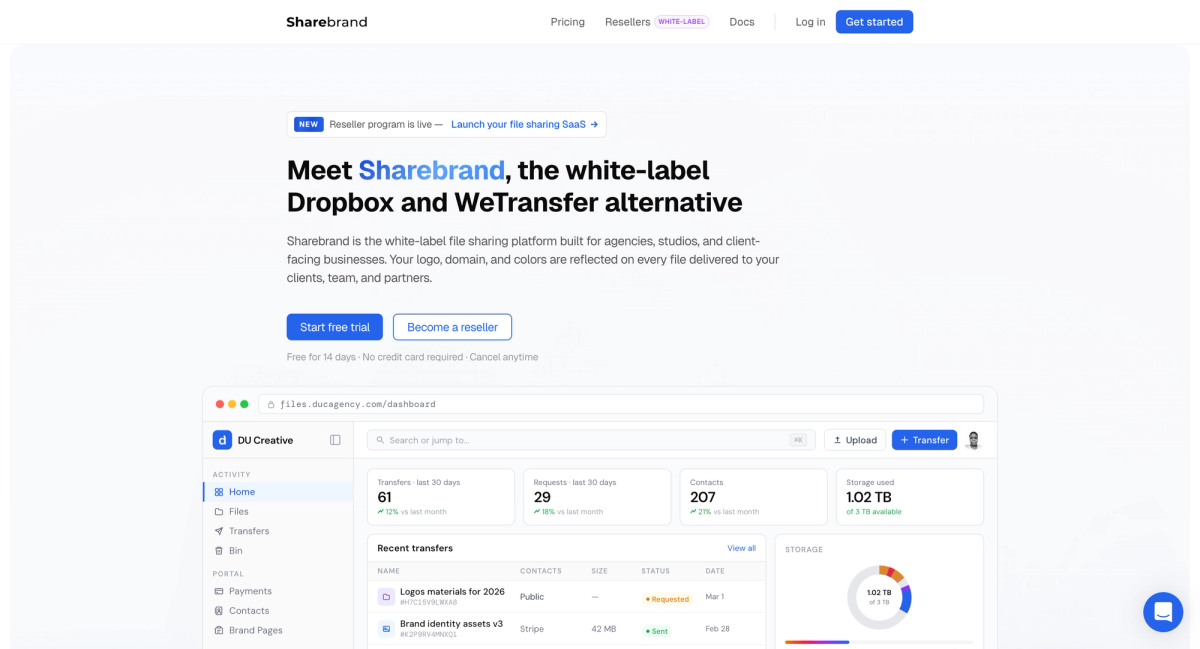
Sharebrand is a white-label file sharing platform built specifically for client-facing businesses: agencies, studios, consultancies, and any team that delivers work to clients as a core part of their business.
When you set up a Sharebrand workspace, you connect your own domain, upload your logo, configure your colors, and set up email delivery from your address. Your clients receive files through a page and experience that looks like something you built. Sharebrand is invisible to them.
The Starter plan gives you 3TB of storage, up to five team seats, and transfers up to 50GB. The Pro plan extends to 6TB, ten team seats, and transfers up to 100GB, and it removes the "Powered by Sharebrand" attribution from client-facing screens. For businesses that want to offer branded file delivery to their own clients under a separate domain, the Reseller plan gives you a pooled storage environment where each client workspace is independently branded.
None of these plans charge per user beyond the included seat count. There is a 14-day free trial with no credit card required.
Sharebrand is not trying to replace Dropbox for internal file sync. If your team needs desktop sync, offline access, and deep integration with Microsoft Office, Dropbox or OneDrive will serve you better. Sharebrand is built for the other half of file sharing: the moment your work leaves your team and lands in front of a client.
Dropbox is a good tool for what it was built to do. It was not built for this.
Sharebrand is a white-label file sharing platform for agencies, studios, and client-facing businesses. Files delivered on your domain, under your brand, with your clients never seeing anyone else's name. Start a free trial at sharebrand.io.